Showing posts with label review. Show all posts

Sunday, 19 May 2013

Tomb Raider: From Ground-Breaking to Water-Treading

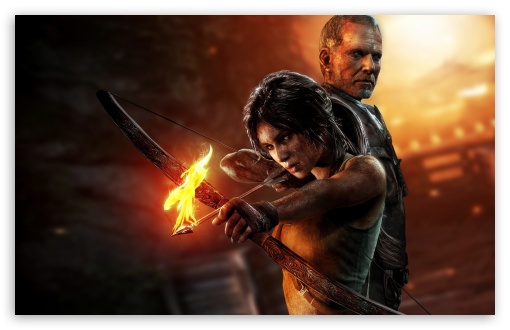
The newest Tomb Raider has been a long time coming. For 16 years the formula of the once jaw-droppingly innovative franchises had gone unchanged, resulting in games that were nostalgically enjoyable at best and broken at worst. Prior to this, the only other times the celebrated heroine had strayed away from her one-woman pack was the cataclysmic-ly bad Angel of Darkness, and the decent but unoriginal Lara Croft and the Guardian of Light, perhaps providing more logic to Core and Crystal's reluctance to stray from the blueprints that had satisfied loyalists for well over a decade. But Tomb Raider 2013 seems different. Crystal Dynamics seem proud that they've mixed things up a bit, it's a whole new story arc for a whole new generation, and, most importantly for them, established fans, reviewers and newcomers alike are loving it. So, does it really match the ambition and forward thinking that the original Tomb Raider had? Or is it just Unchar--DAMMIT IT'S JUST UNCHARTED.


Apparently Lara auditioned for The Hunger Games before making a new game.

I tried to like this. I really did. There's a good balance of open world and linear, scripted battles and spontaneous encounters, and the story's effective in its evolution from simplicity. Simply put, wee lass Lara's boat crashes, and most of the game is about her finding her friends and escaping the crazed island. Lady Croft is more of a human being here than in her previous efforts; she gets burned, cut, bitten, and you see this all via wounds on her body that eventually heal as you play. It's a nice touch. Lara controls nicely, with a magnetic platform-homing thing that means falling to your death is more your own fault than in previous Tomb Raider games, and the simple to learn controls means there isn't much of a tutorial, so you don't feel like you're being spoon-fed how to play. It's also lengthy for a Tomb Raider game, with a little over double the amount of playing time than her other next-gen attempts, all of which were under 10 hours.

Unfortunately, that's where the positives end. For the most part, Tomb Raider is one big exhale of a game. Firstly, there are about six hundred quick-time events during the course of this game, which is about six hundred more than there should be in a game. Lara's character development is incredibly inconsistent. One minute Lara is weeping at the prospect of killing a deer to stop herself from dying of hunger, ten minutes later she's setting dudes on fire and popping bullets through their heads like she's Pam Grier, in what was presumably a gameplay retcon for fans that don't care about emotions and just want the hot lady to kill bad guys already. This isn't hyperbole, the first time she (you) kills a man (via quick-time event), it triggers a cutscene where Lara is talking incoherently to herself, crying and vomiting. It's a shocking, and presumably realistic presentation of a young woman completely ripped of her innocence and optimism. What follows said cutscene is you escaping the location, killing about thirty men without a second's thought as you do so. If you don't take it seriously, it can be pretty funny. But Tomb Raider clearly does take itself seriously, resulting in visceral, brutal melodrama one minute, and thoughtless, blood-thirsty Rambo-ing the next. It's dumb.

There are other aspects of the design that are thoroughly lackluster. The level up system, that allows you to upgrade weapon's and abilities, feels tacked on so they can talk about "customization" on the back of the case. The upgrade's are unoriginal and unnecessary, and is simply a lazy attempt to insert some kind of progression in the game. The various collectibles in the game also feel like an empty addition. Tomb Raider Legend (still the best next-gen Tomb Raider game, despite being, like, 40 minutes long) had a simple and effective collectible system. Easy things to find were bronze, hard things to find were silver, and in each level there was one gold item that you had to scour the area from top to bottom to even hope of finding it. In Tomb Raider 2013, nothing feels distinguished. There are about 6 different types of things you can collect during the game, but nothing seems easier or harder to find, nothing seems more beneficial to your progress, and overall it just doesn't seem very ambitious. The parts of the game that are linear are way too linear and go on way too long for what they are. Put it this way; anyone that played through the game would play those parts the exact same way you did. If that sounds appealing to you, go ahead. It'd be cheaper for me if I just watched a walkthrough on YouTube.

Worst of all, though, Tomb Raider 2013 just isn't very original. As mentioned earlier, it's essentially a worse version of Uncharted, and you can bet your hide Crystal Dynamics did that deliberately, minus the worse. It's truly sad that what was once the genre-defining franchise is now meekly following in the footsteps of a similar, superior series. It brings nothing new to the table, and at its lowest point, feels like Mr. Burns dressing up in a skull shirt and beanie in an attempt to disguise himself as one of the kids. False. Attempting to keep up with an age it doesn't have the stamina for anymore.

Some franchises just aren't meant to span multiple generations. Just let it go.

Thursday, 9 May 2013

Page vs. Screen: A Series of Unfortunate Events

I'm going to say something that seemingly a lot of people don't know; different media platforms require different qualities to be popular. What makes a book good won't always make a TV series good. What makes a film good won't always make a console game good. When you expand a single platform product, alterations need to be made to make sure they succeed on their own merit, while still appealing to die-hard fans. Sometimes this happens, and everyone is happy. Often it isn't. Guess which one A Series of Unfortunate Events is?


Don't get me wrong, the film adaptation of A Series of Unfortunate Events is not a bad film. Jim Carrey is lovably hate-able as all incarnations of Count Olaf, Billy Connolly and Meryl Streep are both stellar in their minor roles, and Timothy Spall, though arguably a rather basic role for his talents, portrays a frighteningly accurate Mr. Poe. The children are probably the least interesting characters in the film, which reflects the book nicely, as three ordinary (well, ordinary compared to the world around them) kids struggle to deal with the weird and ever-changing world around them. The script is slick enough to not feel all over the place, despite the jumpy narrative that comes with mushing three books together. The film is good. The books are better.

It's not hard to see why A Series of Unfortunate Events managed to get a film deal considering its inspiration. The books target a type of child audience no one thought even existed. The gloomy, yet humorous lexis appeal directly to young teenagers that may be feeling similar emotions. The consistent 4th wall breaking helps ease the reader if things get too dark, and at times Snicket feels like a guide, or a companion, giving you a tour of these children's terrible lives. That's the kind of immersion all children's books need, regardless of genre, and it there was a children's literary canon, you can bet you hide I'd be pulling for this to be in it.

So what's the difference between the books and the film? Well, Lemony Snicket isn't funny anymore. Jude Law plays it straight as the unorthodox author who lives in a clock. Carrey takes the comedy torch for the film. The kids don't stay with Mr. Poe like they do in the first book, and, sadly, Olaf's henchmen don't have nearly as big of a part as they do in the books. But overall, not a whole lot. And that's the problem.

A Series of Unfortunate Events: the film, doesn't know what it wants to be. It wants to appeal to kids and parents, and it wants to be a series, so it's light on the graphic imagery that the books contain. But it's still there, and can be quite unforgivably brutal for a PG film. The moral of the film is that good things will eventually override the bad things, but that doesn't really make sense when not a single good thing happens to these kids. But you can't have a big kids blockbuster without a moral. The books don't really have a moral, they're more like a book-umentary. And this is the films big problem. It doesn't know whether to stay true to the source material, or go with its own flow. It ends up in the middle and makes for a slightly disorientating experience.

If you want to see the film, do. You'll enjoy it, probably. But because it is neither a literal film version of thhe book, nor a separate entity from its print counterpart, I can't choose the film over the books.

BOOK OR FILM: BOOK

Monday, 6 May 2013

A Hard Days Night: More like Fab BORE, am I right

The Beatles did it first. Mention just about anything in terms of music and that's often what you'll hear. Like it or not, The Beatles are one of the most influential bands in history, inventing tried-and-tested formulas that are still used to this day. Something that's substantially more debatable, however, is if all of these inventions have been entirely beneficial to music. A Hard Days Night: The Film, is a bizarre creation made solely to promote an album. But does it have any credibility on its own? That depends on how strong your rose-tinted glasses are.

Not even the Upper Class Twit of the Year contest featured this much Tomfoolery.
A Hard Days Night is unique in that it has virtually zero plot. The Beatles get picked up at a concert, do silly things, then do another concert, do more silly things, then do another concert. Credits. There are some loose nods to some kind of continuity and story arc, the band teasing Ringo and Paul's Granddad being unusually clean (?), but the film could literally be played backwards and it would be exactly the same film. Music videos have more of a story than this. And I understand that that's all this really is, a 90 minute music video, but does that really sound that appealing when you think about it?

The movie is meant to be real, so it's shot like a documentary, with lazy camera angles and an unnecessary black and white rendering. The trouble is, nothing goes far enough in its execution to be truly entertaining. No one in this film can act, so nothing ever seems spontaneous, or even fun. The lazy, albeit original at the time, docu-style means the film can't be enjoyed from an artistic standpoint. And the terrible writing leads to me not even finding The Beatles likable half the time.

Look, I love The Beatles, just like you probably do. But let's be honest here. A Hard Days Night is tripe. We need to stop looking at it as 'thing The Beatles did' and look at it as 'film that was actually made for people to pay actual money to see', and maybe things'll seem a bit clearer. I get the lovable rogue thing and I get the mindless innocent fun thing. If you want to watch a lovable rogue, watch Big Nothing. If you want to see mindless innocent fun, watch Airplane!. But there is nothing about A Hard Days Night that makes it enjoyable to watch. Nothing.

John Lennon can mend wars, but not crappy movies. We are learning the extent of his powers. But hey, at least there aren't any terrible, pandering movies about music acts today, right?


Well, yes, but that was a long...


Okay, fine, but he's different. He's got a more specific audience. There isn't someone with true worldwide appeal that...


...bugger.

Wednesday, 1 May 2013

The Devil Inside: Possessions for some, miniature American flags for others!

You know when you accidentally open an unregistered version of Photoshop, and before you get rid of it you have to sit through all the introductory crap and decline to register? It's like, I didn't enjoy this, why would I go out of my way to have more of it? That's The Devil Inside. A messy, boring, infuriating piece of tripe that has me frenzy clicking Esc.

She had the last laugh. She didn't have to see this film.
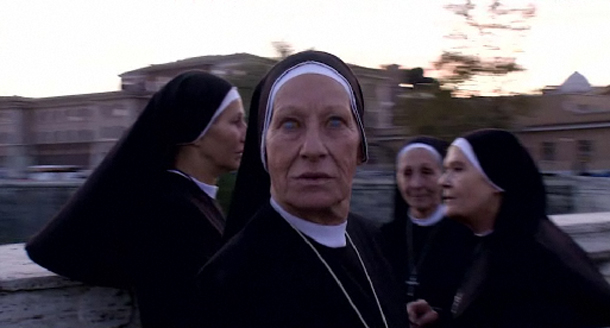
I'm aware plot isn't something that is traditionally too important in horror films, but this is impossible to overlook. Isabella Rossi travels to Vatican City where her mother is being kept for murdering priests. Ma Rossi clearly doesn't like it there, because she's cutting herself. Convinced her mother's possessed, Isabella, and two Priests who Play By Their Own Rules, try and get her exorcised.
That all sounds fine. Not interesting, but fine. There are some things that need to be addressed, though. In the ward where Maria Rossi is kept, the doctor says she reacts erratically to any exposure to religion. Then a couple of scenes later, he happily lets Butch Catholicy and the Exorcist Kid wander in to her room AND THEN LEAVE THEM. A long time after erraticies begin, said doctor begins banging on the door, seemingly unable to get in, but as soon as things die down, he CASUALLY ENTERS LIKE NOTHING HAPPENED. Even worse than that, there's a 5 scene where British Mumbly priest wants to take his findings to the press, and Dara O'Briain priest doesn't want to. Nobody can find out about this, he cries.
......This is a found footage film. It's supposed to be a documentary. I can't.

The performances are dreadful all around. Most of the dialogue is improved, but it seems nobody involved with this film has had a single improv lesson in their lives. Lines are repeated, there's an unreal amount of stuttering, and at times you can seriously see them making things up as they go along. British Mumble priest in particular, who's actual name is Ben Rawlings, has these acting follies up the wazoo. There are full scenes where he is completely incomprehensible, and it's still more enjoyable than the melodramatic run-on sentences that apparantly take priority over plot and character development.

Oh, and everyone in Italy speaks perfect English. Everyone.

I don't need to mention the ending, do I? That horse was beaten to death long ago. What I will say though, is that the last 15 minutes are by far the most interesting, it cuts off way too abruptly, even for a found footage film, and at only 80 minutes, there's time for a whole other act. I guess that sums up The Devil Inside pretty nicely. Two thirds of a passable film.

Saturday, 27 April 2013

Page vs. Screen: The Road

"Too bad we can only carry 200 pounds of food back to the wagon."


There's something about Cormac McCarthy's The Road that makes it mesmerising to read. The frequent paragraphs, the incredible imagery, and distinct lack of punctuation, set it apart from any book written before. Its simplicity forces you to appreciate the book solely for its heart-wrenching plot and surprisingly believable characters, made to survive in a world where it's even worse than others turning on you; you're forced to turn on others. But does the 2009 film manage to follow in the footsteps of its textual predecessor? eehhhhhhhhmmehhmehggh. Not really.

What the film fails to do, which is the biggest mistake it could possibly make when trying to emulate a book like The Road, is stand out. It's still bleak, depressing tale of a man's ultimately fruitless quest to protect his son, but it lacks the unnerving style of which the book is written. Of course, such a thing would be near impossible for a film to do. But nobody forced anyone to make this, and the surrealism of the way the book is written, half of what makes it so great, is completely absent in the film.

To the film's credit, it's acted and directed superbly. They still remember that this isn't a story where you're supposed to laugh, or feel hopeful, or anything really that's positive, and the camera shots really make you feel like your eyes are chained to the screen. The performances are subtle and bleak, but still maintain hints of optimism, particularly in Viggo Mortensen as the father. I hadn't heard of this guy before seeing this film, and I was wholly impressed.

While the 2009 film The Road isn't a bad film by any means, it fails to make an impact like the book version did, by being less inventive with it's style and playing it safer for a more neutered audience. Watch the film on its own and you'll probably find it harrowing. Next to the book though, it's simply somber.

BOOK OR FILM: BOOK

Thursday, 25 April 2013

Better the Devil You Overthrow: The Exorcist

So I saw The Exorcist for the first time last week, and never before had I been so hyped for a film. The records and legacy it had created made it sound like it belonged in the Lost Ark, causing melted faces to anyone fool-hearty enough to sneak a gaze. I was convinced that there was no hope of me ever being able to achieve my aspirations in film without seeing the movie that was seemingly the inspiration for everything, including Blair Witch, Poltergeist and E-Z Bed Recliners. So with all this in mind, was my initial viewing of one of the greatest films of all time skewed and watered down? Yeah, a bit. Was it still one of the best films I've ever seen? GOD. DAMN.


Pazuzu! You ungrateful gargoyle!


There's something about The Exorcist that sets it apart from any other horror film that's ever been made, before or since. The obvious thing is how much care and attention has been put into every shot, every scare, every line of dialogue. Today's horror films have a plot that can usually be explained in one dreary line ("they were performing an exorcist...........*cough*.........on her"). But The Exorcist manages to keep a plot that is both simple and fleshed out to the finest detail. Not a single time when I was watching was I just waiting for the next scare, because, in what is such a rarity in horror films, the scenes without scares actually mattered. I cared about the characters. Why? I don't know, maybe because they took a minute to develop them instead of throwing them in terrifying (for them, not us) situations. Of course, it helps that every single actor performs to an incredible standard, unheard of in horror films. I'm beating you over the head with the same point here, I know, but seriously, why aren't all horror films this polished? What Abner Doubledeal decided that horror will be the genre where corners can be cut, scripts can be half-arsed, and actors whose delivery wouldn't get them cast in an advert alerting people of the dangers of strokes?

I realise that there have been a handful of horror films that are very well made and don't deserve the scorn that The Exorcist has forced me to condemn them with. And I've always hated saying, in regards to great things, that nothing will ever top it, because how pessimistic is that? But if I ever see a horror film in my lifetime make as lasting an impact as The Exorcist, I'll watch the Paranormal Activity films back to back. That seems suitable punishment for my insolence.